Aug 17, 2026
Evictions, rent disputes and maintenance dominated the conversation. Again and again, people were simply trying to work out what to do next.

Spend a few minutes in any landlord forum and a pattern starts to appear. One person has a tenant who has stopped paying rent. Another is unsure which notice to use. Someone else is trying to coordinate a repair while figuring out who is responsible for the damage. The details change, but the question underneath them is often the same: what am I supposed to do next? That question is what sent us into the research.
At Almond, we spent time reading public conversations across Facebook, Reddit, X and other social channels. We wanted the unfiltered version of property management, including the questions people ask when they are frustrated, unsure or already dealing with a problem.
We then completed a structured review of 4,593 posts from r/OntarioLandlord and r/Landlord. Of those posts, 4,416 contained relevant material. Since one post could mention several problems, the review produced 5,546 separate issue observations. We also looked more closely at 2,232 posts from the Ontario community to see whether local rules and processes changed the picture. They did not change it very much. The same three issues kept rising to the top.
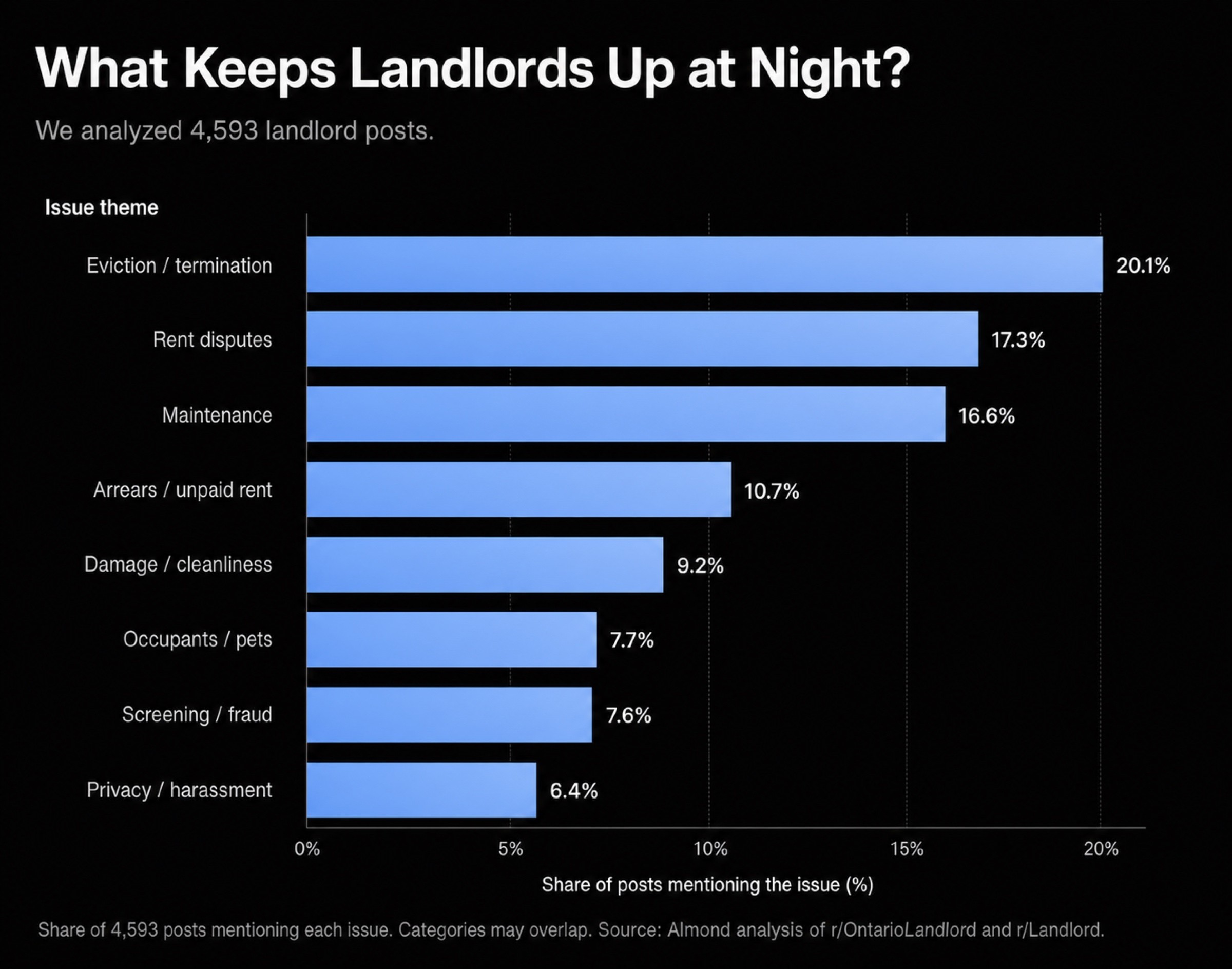
Figure 1. Eviction, rent disputes and maintenance are the issues that appear most often. Source: Almond analysis of 4,593 posts from r/OntarioLandlord and r/Landlord. Categories may overlap.
The Eight problems that appeared most often
The Ontario results closely followed the broader sample. The order changed slightly in a few places, but the leading issues remained remarkably consistent. This is not a census of every landlord or tenant, and people are more likely to post online when something has gone wrong. Even so, the repetition gives us a useful picture of where property management becomes confusing.
1. Eviction and lease termination (20.1%)
Nearly one in five posts involved eviction or the end of a tenancy. A landlord may have a valid concern and still be unsure which notice applies, when it can be served, what needs to be documented or when an application can be filed.
Nonpayment of rent, serious damage, repeated late payments, interference with other tenants, personal use and major renovations can all lead to different processes. A form that is correct in one situation may be wrong in another. The official Landlord and Tenant Board forms library shows how many different circumstances and filing requirements a landlord may need to navigate.
2. Rent increases and financial disputes (17.3%)
On a spreadsheet, rent is a number. In practice, it comes with dates, notices, exemptions, receipts, utilities, deposits and a record of what happened before. Even an ordinary increase requires the landlord to know when the previous increase took effect, whether the unit is covered by the provincial guideline, which form to use and how much notice is required.
Ontario explains the general rules on its residential rent increases page, but applying those rules still depends on the unit, its occupancy history and the existing tenancy. That is why a routine financial decision can quickly turn into a dispute.
3. Maintenance and habitability (16.6%)
Maintenance appeared in almost one out of every six posts. Picture a tenant reporting water under the kitchen sink. Someone has to decide whether it is urgent, arrange access, find the right vendor, approve the cost and keep the tenant informed. If the leak has happened before, that history matters too.
By the time the repair is finished, the issue may have involved the tenant, a property manager, a plumber, the owner and an insurance provider. Slow communication makes a small issue feel ignored, while missing history leads teams to treat recurring problems as new ones. The challenge is not opening another maintenance ticket. It is having enough context to get the right work done and confirm that it was completed.
4. Rent arrears and unpaid rent (10.7%)
A late payment is more than a missing transaction. It may lead to a conversation, a payment plan, a formal notice or an application. What the landlord communicates and records along the way can matter later.
This is where scattered information becomes a real problem. The lease may be in one folder, payment records in a spreadsheet, and conversations split between text messages and email. Deadlines may live in someone’s calendar, assuming they were recorded at all. The landlord is left trying to hold the whole story together.
5. Property damage and cleanliness (9.2%)
Damage disputes often begin with a basic question: is this normal use, poor upkeep or damage caused by a tenant or guest? The answer can affect who is responsible, what evidence is needed and whether the issue becomes part of a larger dispute.
Photos, inspection records, repair invoices and communication history become important when people remember the condition of a unit differently. Without a consistent record, the conversation can turn into one person’s account against another’s.
6. Unauthorized occupants and pets (7.7%)
Posts in this category raised questions about guests, roommates, sublets, pets and people who appear to be living in a unit without being named on the lease. These situations are difficult because the rules can depend on the jurisdiction, the type of tenancy and what is actually happening in the unit.
The operational challenge is knowing what the lease says, what the law allows and whether the concern is based on a documented pattern or a one time observation. Without that context, landlords can act too quickly or allow a manageable concern to grow.
7. Tenant screening and application fraud (7.6%)
Screening is supposed to help a landlord understand who is applying for a home. In practice, landlords may be reviewing employment information, income documents, references, credit history and identification while trying to follow privacy and human rights requirements.
The posts we reviewed included concerns about altered documents, unreliable references and information that could not be verified. The challenge is finding a process that is consistent, fair and well documented without turning every application into an investigation.
8. Privacy, lawful entry and harassment concerns (6.4%)
Landlords sometimes need access to a unit for repairs, inspections or other legitimate reasons. Tenants also have a right to privacy and clear communication about when someone will enter their home. Problems arise when notice is missing, access is poorly coordinated or communication becomes excessive.
These posts are a reminder that property management is not only about completing the task. How the task is communicated and documented can shape whether the interaction feels routine or becomes a serious conflict.
What the eight problems have in Common:
Property management is several jobs under one name
A landlord is part building operator, bookkeeper, customer service representative, project coordinator and record keeper. In Ontario, the role also comes with a detailed legal framework that shapes many everyday decisions. That combination explains why relatively ordinary events can become difficult so quickly.
A missed rent payment touches finances, communication and legal procedure. A broken appliance touches service, scheduling, access and cost control. A complaint about another occupant touches the lease, tenant relationships and documentation. The property is the physical asset, but much of the actual work happens in conversations, decisions and follow through.
Information is everywhere. Context is harder to find
There is no shortage of information for landlords. Government websites, forms, articles, forums, property managers and legal professionals all have a role to play. The problem is finding the right information at the moment it is needed and connecting it to the history of a particular unit or building.
What does the lease say? Has this happened before? Which building rule applies? Who spoke with the tenant? Was a vendor contacted? What was promised? When is the next deadline? Those answers often live in different places. When they do, the landlord or property manager becomes the system responsible for connecting them. That may be manageable with a few quiet units, but it becomes fragile as the number of properties, tenants, vendors and team members grows.
Better operations are better for tenants too
Making property management easier for landlords does not have to come at the expense of tenants. Clearer operations can mean faster repairs, fewer missed messages and more consistent follow through. Tenants should not have to explain the same maintenance issue to three different people. Property managers should not have to search through months of messages to understand what happened, and owners should not learn about a recurring building problem only after the cost has escalated. Everyone benefits when there is a reliable record and someone is clearly responsible for the next step.
Where Almond fits
We built Almond around the messy middle of property operations, where a conversation needs to become a task, a task needs to reach the right person and the result needs to become part of the building’s history. Almond brings together leases, building rules, vendor scopes, work history and communication so property teams can coordinate tenants, staff, vendors and owners without losing the context behind each request.
AI should not replace human judgment, especially when a decision affects someone’s home or legal rights. It can make the surrounding work more organized by surfacing relevant information, keeping track of what needs attention and preserving a clear record of what happened.
Our research did not uncover one dramatic new problem. It showed how often the same ordinary problems create uncertainty. Owning the building may make someone a landlord, but running it well requires a reliable way to remember, coordinate and follow through. That part of the job can get much better.


